

You Might Also Like
WhatsApp, Telegram +66-957-269-990
- info@gophukettours.com


Everything you need for a smooth visit to the white statue on Nakkerd Hill: what to wear, how donations work, when the light and crowds are best, and how to link it with Wat Chalong and Old Town.

You can see it from the road long before you get there: a pale white figure sitting on the green ridge above Chalong, oddly calm above the traffic and the scooters. Sooner or later, everyone on the island asks the same two things about Big Buddha Phuket: is it worth the drive up, and what do I need to wear? It is worth it, and the answer to the clothing question will save you some awkwardness at the top.
This is a short stop in terms of time, but it sets the tone for a day of seeing the island beyond the beach. Get the timing and the clothes right and it is one of the best easy half-days in Phuket. Get them wrong and you are in a borrowed sarong in the midday sun, waiting behind a tour bus.
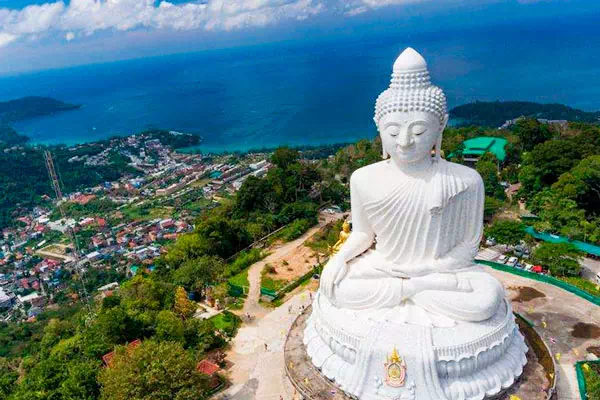
The Big Buddha is a 45-metre white statue seated on top of Nakkerd Hill, in the south of the island. It is a working place of worship as well as a viewpoint and one of Phuket's main attractions, so treat it the way you would treat a temple. Its Thai name is Phra Phutta Ming Mongkol Akenakkiri, though almost everybody just calls it the Big Buddha.

The statue is faced with white marble that catches the light beautifully, particularly when the sun is low. It is a fairly modern monument, not an ancient one, and it has been built gradually with money from donations. You may well see scaffolding, building materials or work going on somewhere on the site, and that is part of the story.
Next to the main figure, you will find a smaller golden Buddha, shrines, and a covered hall at the base where people come to pray and receive a blessing from a monk. Strings of small bells ring in the wind around the terrace. That sound, with the wind on the hill, is what most people remember after they leave.
Do not expect a long list of things to do. You walk up, look at the statue from close by, enjoy the views, sit in the shade for a while and leave. For most visitors that makes for a pleasant, unhurried stop rather than a whole-day attraction.
Yes, and for many visitors the views from Nakkerd Hill are as good a reason to come as the statue. On a clear day you look down on Chalong Bay on one side and towards Kata and Karon on the other, with the green hills in between. It is one of the widest panoramas you can reach without any hiking.

The terraces around the statue give you different angles, so take a slow lap instead of stopping at the first railing. On the Chalong side you see the boats scattered across the bay, and on the western side the coast opens up towards the Andaman Sea. There are benches and shade, though there is never quite enough of either in the high season.
Haze and cloud are the main spoilers. In the rainy months, the hill can be wrapped in mist, and the white statue fades into a white sky. It still has an atmosphere in those conditions, but you will not get the postcard view, so aim for a clear day if the view is your reason for coming.
If you love viewpoints, combine this with others on the same trip. Karon Viewpoint, the Windmill Viewpoint and Promthep Cape are all in the south of the island, and each gives a different angle on the same coast. I would not visit all of them on your own in a single afternoon unless you enjoy riding hills.
Cover your knees and shoulders. That is the rule that decides whether you feel comfortable at the top, for men and women alike. Shorts above the knee and tank tops are not appropriate here, even if the weather makes you want to wear them.
Sarongs are often available at the entrance to borrow, but I would not count on one being clean, free or spare when you arrive. The simplest solution is to carry your own light scarf or sarong in your day bag, and put it on before you walk up the steps. It also protects you from the sun, which on that bare hilltop is no small thing.
| Item | Good choice | Avoid |
|---|---|---|
| Top | Loose T-shirt or light shirt with sleeves | Tank tops, crop tops, swimwear |
| Bottom | Long skirt, loose trousers, sarong | Short shorts, short skirts |
| Feet | Sandals you can slip off easily | Complicated lace-up shoes |
| Extras | Hat for outdoors, water, sunscreen | Hats inside the shrine halls |
Behaviour counts as much as clothes. Take your shoes off where others do, keep your voice down around people praying, and do not point your feet at a Buddha image or at a monk. Women should avoid touching a monk or handing him anything directly: put it down or ask someone for help.
Photos are generally welcome, but use common sense. Do not climb on anything, do not pose with your back turned in a way that looks disrespectful, and do not push in front of someone who is praying. A respectful visitor gets smiles here. A loud one gets quiet looks.
There is generally no big entrance ticket for the Big Buddha, and the site relies on donations from visitors. You choose what to give, and nobody should pressure you into a specific amount. Donation boxes are placed around the site, and check on the day in case anything has changed.
A popular way of giving is to buy a small marble tile or a little bell and write your name or a wish on it. The tiles have traditionally been used in the construction, while the bells are hung along the terrace, where you can hear them ringing. It is a nice thing to do with children, as it gives them something to hold and something to remember.
You can also receive a short blessing from a monk in the covered hall, usually in exchange for a small donation of whatever you like. He may tie a white or coloured string around your wrist. Kneel, keep your head lower than his if you can, and leave the string on until it falls off, as locals do.
Carry small notes for donations, drinks and the like, since small stalls may not take cards. Nothing here needs to be expensive, and my advice is simple: give what feels right, and do not worry about whether it is enough.
Early morning and late afternoon are best. Before the tour groups arrive, you get cooler air, softer light and a much quieter terrace. Midday is the time to avoid: the marble glows, the heat is strong and the coaches have all arrived.

Late afternoon is my favourite. The sun drops towards Kata and Karon, the statue turns warm, and the hilltop breeze feels great after a hot day. The downside is the ride back: the road is steep and winding, and if you are on a scooter you do not want to do it in the dark without some experience.
The drier season, from around November to April, brings the clearest skies but also more visitors. The rainy months are quieter, with greener hills and a higher chance of cloud on top. The month by month Phuket weather guide can help you decide when you are planning your wider trip.
Opening hours run roughly from early morning until around sunset, but they can change, especially around religious holidays. Buddhist holy days bring more local worshippers and a very special feeling, so a visit then is lovely, as long as you dress and behave with extra care.
The easiest options are a taxi or ride-hailing car for most people, a scooter for confident riders, or an organised tour if you want the whole route handled. There is no practical public transport up the hill, so you will need your own wheels or a booked ride.
| Option | Good for | Downside |
|---|---|---|
| Taxi or ride-hailing app | Couples and families who want a simple trip | You may wait a while for a ride back from the top, so ask the driver to stay |
| Rented scooter | Confident riders, flexible timing | Steep, winding road; slippery after rain |
| Rented car | Families visiting a few places | Parking is tighter at busy times |
| Phuket City Tour | First-time visitors who want everything in one day | Fixed schedule, less time at each stop |
The turning for the hill is signposted from the main road between Chalong and the south of the island, and the road climbs through forest with some good views on the way. You may pass elephant camps on the lower slopes. I would skip riding one, and the article on ethical elephant experiences near Phuket explains why and what to choose instead.
A word about scooters. If you have never ridden on steep bends, this is not the place to learn, particularly after rain. Wear a helmet, go slowly on the way down, and be honest with yourself about your experience. Plenty of scooter accidents on the island happen on just this kind of road.
The natural route is Big Buddha first, then Wat Chalong, then Old Town in the late afternoon. Wat Chalong is close to the bottom of the hill, so these two sights pair easily, and Old Town works best once the heat eases.

Wat Chalong is the most important Buddhist temple in Phuket, with beautiful murals and Buddha statues, and a very different feel from the open hilltop. It is lively and colourful, and you may hear firecrackers going off as people give thanks for a wish that came true. Do not be alarmed: it is normal here.
After that, head to Old Town for Sino-Portuguese shophouses, cafes and a late lunch or early dinner. It deserves more time than a quick walk through, so do not squeeze it in as an afterthought. Tired feet and a cold drink in a shophouse cafe are the best way to end this kind of day.

The easiest way to link all of this is the Phuket City Tour, from ฿1090 with hotel transfer, a 6-hour route through viewpoints, the Big Buddha, Wat Chalong, Muay Thai Street, Rang Hill, Old Town and more. The itinerary also includes a baby elephant feeding stop, so if that is not for you, mention it when you book or just sit that one out.
To be honest, it is a busy day, with a lot of stops in a short time, and you will not linger for long at any one place. But it suits first-time visitors with no car, and the tour description promises no pressure to shop, which is a real relief in Phuket. If you want to see the island's main sights in one go without driving, this one suits you:
Travellers who have already done the sights and want a contrast can look at the top 5 Phuket tours list and save the Big Buddha for a free afternoon by taxi.
Bring a light layer for your knees and shoulders, water, sunscreen and a hat. Everything else is optional. The hill has little shade in the open areas, so a hat and water are the things you will miss most.
Plan on a relaxed visit, take a slow lap around the terrace, and sit down for a while before you leave. The view, the wind and the bells are the best part, and they cost nothing.
The statue stands 45 metres tall on top of Nakkerd Hill. That height, plus the hill itself, is why you can see it from far across the south of the island.
Most people are happy with a relaxed stop of less than a couple of hours, including time for photos and the views. A short visit also works well if you are moving on to Wat Chalong. There is not much to do beyond the statue and terrace.
Short shorts are not appropriate, because knees should be covered. Long shorts that reach below the knee or a sarong over shorts are a good solution. Carry your own layer rather than relying on what is at the entrance.
Yes, since a car or scooter can take you close to the top and the walk from the parking area is short. There are some steps around the statue, and the heat can be tiring for small children. Morning and late afternoon visits are much easier for everyone.
The site does not close for ordinary rain, but steps and terraces can be slippery. Cloud can also hide both the statue and the view. Wait for a break in the weather if you can, particularly if you are on a scooter.
Yes, the western side of the terrace faces towards the sea and catches the late light well. Check the closing time on the day, and plan your way back down before dark if you are riding a scooter. Promthep Cape is the more famous sunset spot on the island.
The Phuket City Tour includes the Big Buddha along with many other sights in a 6-hour day, so the stop is not long. It is enough to see the statue, take in the views and take photos. If you want a long, quiet visit, go separately by taxi.
Hotel pickup, insurance and a licensed local operator. Ask us anything on WhatsApp before you book.
Updated 22 November 2026.