
You Might Also Like
WhatsApp, Telegram +66-957-269-990
- info@gophukettours.com


A practical walking route through the old town's shophouses, shrines, street art and noodle shops, with the best times of day and an honest take on the Sunday walking street.

By ten in the morning the sun is already bouncing off the pastel walls of Thalang Road, and the coffee you promised yourself is starting to look like a rescue mission. Old Phuket Town rewards people who come at the right hour with comfortable shoes and no strict plan. It is the one part of the island where you can spend a whole morning without seeing a beach, and not miss it.
Here is the route I give friends, with the streets, shrines and food stops that are worth your time, and the bits you can happily skip.
Yes, especially if you have had enough of beach clubs. Old Phuket Town is the island's real history in one small, walkable grid, and half a day is enough to see the best of it.
The town grew rich on tin. From the 19th century, mining brought waves of Hokkien Chinese workers and merchants to Phuket, and the families who made money built the long, narrow shophouses you see today. The style is usually called Sino-Portuguese: Chinese layouts and carved details, with European arches, shutters and stucco borrowed from colonial trading ports such as Penang.
Look for the covered walkway along the shopfronts, known locally as the five-foot way. It kept people out of rain and sun, and it still does. Many houses go surprisingly deep behind their thin facades, with air wells letting in light in the middle.
Be realistic about what you are getting. This is a living town with traffic, delivery vans and overhead cables, not a preserved museum. Some shopfronts sell the same souvenirs, and on a Monday morning parts of it feel half asleep. That is also why it feels like a real place.
Walk Thalang Road first, cut through Soi Romanee to Dibuk Road, then continue west along Krabi Road. This short loop covers most of the finest buildings, and you can do it slowly in a couple of hours.
Street art is scattered across all of these. You will find large murals on side walls around Thalang, Soi Romanee and Krabi Road, some showing old town life and some just playful. There is no need for a map: part of the fun is turning down a side lane and finding one.
A small tip on photos. Many shophouses are private homes with families living upstairs, so ask before you take pictures through open doors. Most owners of small shops are friendly if you buy a coffee or a snack first.
What can you skip? The souvenir shops selling the same magnets and elephant trousers. The clock tower at Surin Circle makes a quick photo, but it does not need a special trip.
Go early in the morning or from late afternoon onwards. Midday is the worst time: the pavements hold the heat and shade is patchy, even on a pleasant day.

Each part of the day gives you something different, so choose by what you want from the walk. Rang Hill, a short ride above town, is worth adding at the end for the view over Phuket Town and a cooler breeze.
| Time of day | What it is good for | Downside |
|---|---|---|
| Early morning | Empty streets, soft light, breakfast with locals, shrines at their quietest | Many shops and cafes are not open yet |
| Late morning | Cafes and shops open, museums, a proper coffee stop | Heat builds quickly, and tour groups begin to arrive |
| Midday to mid-afternoon | A long lunch and an air-conditioned cafe, nothing more ambitious | Hot, bright light for photos, and some places close for a break |
| Late afternoon | Warm light on the facades, comfortable walking, sunset at Rang Hill | Some family shops start closing |
| Evening | Dinner, bars, lit-up buildings and Sunday market | Less to see of the architecture, though the mood is lovely |
My own favourite plan is to arrive around breakfast, walk until the heat turns, have lunch and go back to the beach. The second-best plan is a late afternoon walk, dinner in town and a taxi home.
The time of year changes this too. In the rainy months, showers often mean you can walk under the five-foot ways and enjoy a very quiet town. For the wider picture, this month by month guide to Phuket's weather will help you plan.
It is worth one evening if you are in town on a Sunday, but it should not be your only look at the old town. Thalang Road closes to traffic from late afternoon and fills with food stalls, music and crowds, so you go for the atmosphere, not the buildings.

The market is known locally as Lard Yai, which means big market. Expect grilled seafood, sweets, handmade crafts, T-shirts, street performers and people shuffling along at a slow pace. It often runs into the late evening, though wet weather can cut it short or thin it out.
I enjoy it most for the food and the mix of local families and visitors. What I would not do is rely on it to see the old town, because the stalls hide the facades and the crowds make photos difficult. If you can, walk Thalang Road on an earlier morning as well, so that you see both sides of it.
Keep it simple: bring small notes, carry your bag in front of you, and buy food in small amounts so that you can try more. Traffic around the old town gets heavy on Sunday evenings, so arrange your ride home with some patience in mind.
See the Shrine of the Serene Light first, then Jui Tui and Put Jaw together. These three are the most rewarding, and they show how central Chinese faith still is in this town.

The contrast is part of the fun. A Thai Buddhist wat such as Wat Mongkhon Nimit, a few blocks from Thalang Road, has tiered roofs and gilded details, while a Chinese shrine is smaller, darker and full of incense smoke, red lanterns and carved dragons.
The Shrine of the Serene Light is the one people miss. It sits at the end of a narrow alley off Phang Nga Road, behind the shophouses, and it feels almost secret. Many people walk straight past the entrance, so keep an eye out for it. Once you are inside, it stays calm even when the street outside is noisy.
Jui Tui, on the edge of the old town near Ranong Road, is the big one, and it is the centre of the Phuket Vegetarian Festival. Put Jaw, right beside it, is considered one of the oldest Chinese temples on the island. Locals still come to shake fortune sticks and burn incense, so give them room.
If you visit during the Vegetarian Festival, usually in late September or October, the mood changes completely. Firecrackers, processions and some very intense rituals take over these streets. It is extraordinary, but it is not for sensitive ears or small children.
Basic manners are simple:
Start with Hokkien noodles and a local breakfast, then find a cafe for the hot hours. The old town's real food is Phuket-Hokkien, and this is the one place on the island where it is easy to find.
Dishes to look for include mee Hokkien (thick yellow noodles fried with pork and seafood), moo hong (slow-braised pork belly with black pepper and five spice), and oh tao, a sticky oyster and taro omelette. For breakfast, try local dim sum or kanom jeen, rice noodles with curry and fresh herbs. On a hot afternoon, the shaved-ice dessert called oh aew is a good way to cool down.
For a traditional meal, Raya on Dibuk Road and One Chun are long-time favourites for Phuket-style cooking, especially for crab curry and moo hong. Lock Tien, on the corner of Yaowarat and Dibuk, is a simple food court with old-town snacks at local prices. Opening days change, so check before you make a special trip.
Cafes are everywhere, and many are set inside restored shophouses. My advice is to choose by the building rather than the menu: order a coffee or an iced Thai tea, then ask if you can look at the courtyard or the back rooms. Some of the prettiest are on Thalang, Krabi and Phang Nga roads, and new ones open and close all the time.
Be aware that the old town is not as cheap as it was, particularly at the most photogenic cafes. Noodle shops and shared-table local places remain good value, and they often close by early afternoon, so eat your noodles first and your cake later.
Walk alone if the old town is your main interest. Take the Phuket City Tour if you also want Big Buddha and Wat Chalong in one day without arranging transport.

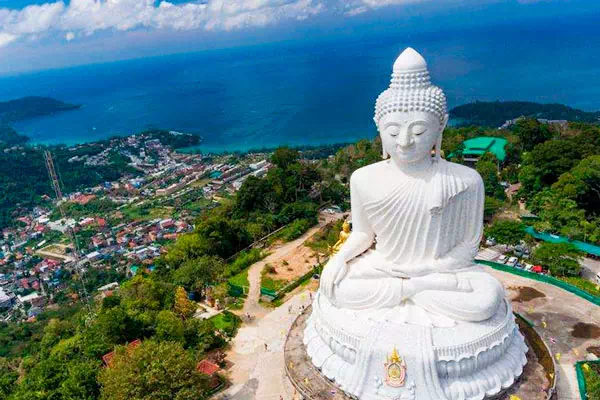
The Phuket City Tour costs from ฿1090 and lasts 6 hours by minibus with a guide and a round-trip hotel transfer. It stops at the 45-metre Big Buddha on Nakkerd Hill, Wat Chalong, Karon Viewpoint, the Windmill Viewpoint and Promthep Cape, and it includes Rang Hill, Muay Thai Street and the old town.
The honest trade-off is depth. The old town is one stop in a long list, so you will get a taste of it rather than a slow wander, and there will be no time for a long lunch on Dibuk Road. The tour's appeal is that it joins up sights that are spread far apart, and nobody has to bargain with a taxi or ride a scooter on hill roads.
So who is it for? First-time visitors on a short trip, families, and anyone staying at the beach who wants to see the island's sights in one go. If you would rather spend your time on the water, the top 5 Phuket tours list may suit you better.
A good combination is to take the tour early in your stay, then come back alone to any place that you liked. Old Phuket Town is exactly the sort of place that repays a second, slower visit.
The tour suits first-time visitors who want the island's big sights joined up in one easy day.
Wear comfortable shoes, bring water, and allow time for traffic in both directions. Cover your knees and shoulders if you plan to enter temples, on foot or on the tour.

Getting there depends on where you are staying. Taxis and ride-hailing apps work from the beaches, and a local pink bus runs from the town market, which is a cheap and very slow way to see the island. Check fares before you get in. From the west coast, the journey can take a while in the evening rush hour, so do not plan things too tightly.
A short checklist for your day:
Take your time, step inside places that look interesting, and leave the map in your pocket for a while. If you decide you would like a guide and a minibus after all, you can send a booking request or ask a question on WhatsApp through gophukettours.com.
Half a day is enough for the main streets, a shrine or two and a meal. Add an evening if you want dinner in town or the Sunday market. It is compact, so you do not need a full day unless you love cafes and museums.
Not quite. Phuket Town is the island's working capital, with offices, malls and schools, and the old town is its small historic centre. When people talk about walking the old town, they usually mean the streets around Thalang Road.
It works for a short visit, especially with snacks and colourful murals to look for. The heat, narrow pavements and traffic make long walks hard for small children. Go early, and keep the route short.
The streets are always open, but some family shops, cafes and restaurants close on certain days. Mondays can feel quieter, which is fine for photos. Check opening days if you have a particular restaurant in mind.
Yes, it is one of the better rainy-day options on the island. The covered walkways, cafes and museums give you shelter between showers. The Sunday market is the part most affected by bad weather.
Generally yes, and the main streets stay lively in the evening. The usual care applies: watch your bag in the Sunday crowds and watch for scooters when you cross the road. Side lanes are quieter and less well lit, so stay on the main roads if you are alone.
No, it is easy to explore by yourself, and getting a little lost is part of the charm. A guide adds stories and context about the tin years and the families behind the buildings. If you want a guide for the wider island too, a city tour makes more sense.
Hotel pickup, insurance and a licensed local operator. Ask us anything on WhatsApp before you book.
Updated 15 November 2026.