You Might Also Like
WhatsApp, Telegram +66-957-269-990
- info@gophukettours.com


What to wear, when to take your shoes off, how to behave around monks and what not to photograph, with real examples from Wat Chalong and Big Buddha in Phuket.

The taxi drops you at the gate of Wat Chalong at ten in the morning, it is already hot, and you are still in beach shorts and a vest. Then you notice the Thai family ahead of you, all covered to the knee, slipping off their sandals without even looking down. Thailand temple etiquette comes down to small moments like this, and once you know a handful of rules they take no effort at all.
I have lived on Phuket for years and walked plenty of visiting friends through temples. Nobody has ever been shouted at. Thai people are forgiving with foreigners who are clearly trying, so treat this as a way to show respect and feel at ease, not as an exam.
The short answer: dress modestly, take your shoes off indoors, keep your feet low and pointed away from sacred things, and stay calm and quiet. Those four habits cover nearly everything you will meet at a temple anywhere in the country.

It helps to remember what a wat actually is. It is not a museum with a nice roof. Monks live there, families come to make merit, and people arrive with real worries: an illness, an exam, a new business. You are a guest in somebody's spiritual home, and that one thought will answer most questions before you need to ask them.
Here is the whole thing on one screen, worth saving to your phone before a day of sightseeing.
| Situation | Do | Don't |
|---|---|---|
| Clothes | Cover shoulders and knees, choose loose fabric | Swimwear, vests, short shorts, see-through tops |
| Shoes | Remove them outside halls with Buddha images | Wear them inside, or step on the door sill |
| Sitting | Tuck your legs to one side, feet behind you | Stretch your feet towards a Buddha or a monk |
| Monks | Give way, keep lower, speak softly | Touching a monk or handing him items directly (women) |
| Buddha images | Treat every image as sacred, whatever its size | Climb, touch the head, or pose for a joke photo |
| Photos | Ask first, turn off flash, read the signs | Shoot people mid-prayer or block worshippers |
Cover your shoulders and your knees, men and women alike. This is the one rule that can actually stop you at the gate, so it is worth getting right before you leave the hotel.
A T-shirt with sleeves and light long trousers or a long skirt is perfect. Men in sleeveless shirts get turned back just as easily as women in crop tops, and this surprises people. Avoid tight or see-through clothing too, even if it technically covers you. Football shirts are fine, a bikini top under an open shirt is not.
The easiest trick on Phuket is a large cotton sarong in your day bag. It weighs nothing, wraps round your waist over shorts, and covers your shoulders if you are wearing a vest. Many tourist temples lend or rent wraps at the entrance, but I would not rely on it, and borrowed wraps have usually been worn by a lot of sweaty people that morning.
The heat is the honest downside. You will be hot in long clothes on an exposed hill at midday, so go early or late, and read our notes on the best time to visit Phuket if you are still choosing dates. Linen and thin cotton beat anything synthetic.
If you have a tattoo of the Buddha or another religious image, cover it while you are at the temple. Many Thais find them deeply uncomfortable, especially on the lower body.
Take them off before you enter any hall, shrine room or building with a Buddha image inside. If you see a row of shoes at the bottom of the steps, add yours to the row, and you will not go wrong. Outdoors in the courtyard and gardens, you normally keep them on.

Flip-flops or slip-on sandals are the practical choice, because you may do this six or seven times in one visit. Lace-up trainers get annoying fast. Socks are not needed, and bare feet are completely normal.
Watch the door sill. Many temple doorways have a raised wooden threshold, and tradition says you step over it, not on it. Some Thais believe a spirit lives there. Nobody will scold you for a slip, but it is a nice detail to get right.
Marble floors and steps get scorching by noon, which is another good reason to arrive early. Theft of shoes is rare, though I would leave your expensive pair at the hotel for peace of mind.
In Thai culture the head is the highest and most respected part of the body, and the feet are the lowest. Pointing your feet at a Buddha image or a monk is the classic visitor mistake, and it is the one you are most likely to make without noticing.
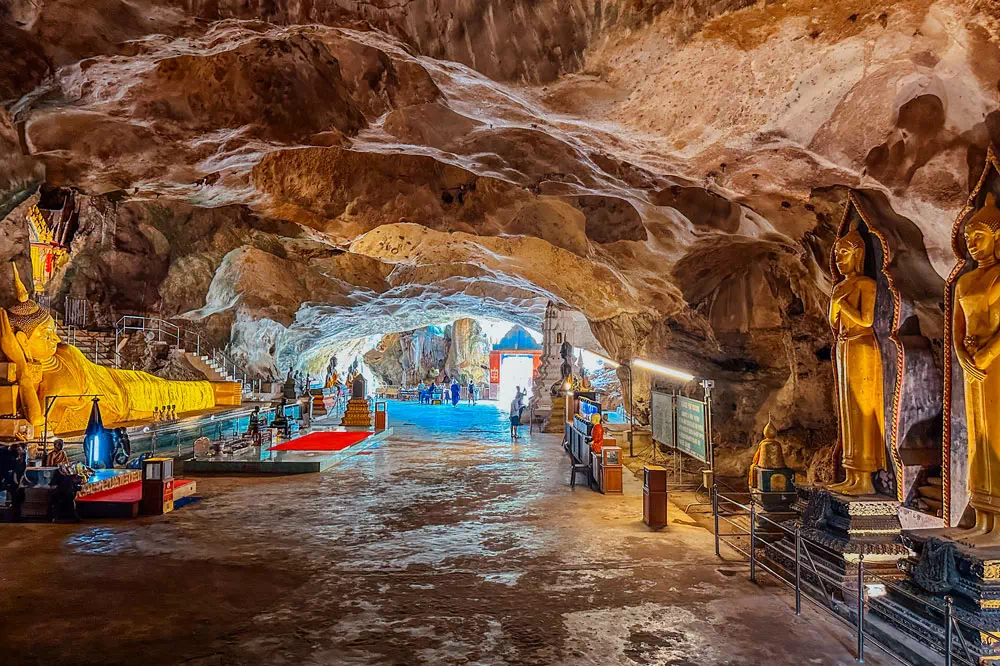
When you sit on the floor of a prayer hall, kneel or tuck your legs to one side with your soles facing behind you. Thais call it the polite way to sit and it gets uncomfortable fast, so change sides whenever you need to. Just do not stretch your legs out towards the altar. If your knees are bad, sit at the back near a wall, or simply stand quietly at the side.
Do not step over people sitting on the floor, or over their belongings. Walk around. Do not use your foot to move a door, a bag or a donation box, and do not put your feet up on a railing or low wall. This applies well beyond temples, and it is a good habit for your whole trip.
The head rule is simpler: do not touch anyone's head, and that includes the cute Thai child who just smiled at you. Parents and grandparents may do it, you should not.
Give monks space, speak softly and keep your manners simple. Women must not touch a monk or pass anything directly into his hand, because monks have taken vows that forbid physical contact with women. An accidental brush can oblige a monk to carry out a purification, so give way on narrow paths and stairs.
If a woman wants to give something to a monk, she can place it on a nearby table or on the cloth he lays out, and he will pick it up. Men can hand items over normally, using both hands or the right hand supported by the left.
When a monk is seated, try not to stand over him. Sit or crouch slightly if you are talking to him, and do not sit next to him. If you are greeting him, a wai (palms together at chest height, head slightly bowed) is the right gesture, and he will not return it. That is not rudeness, it is how the hierarchy works.
Many monks are friendly and curious, especially younger ones who want to practise English. A polite chat is welcome. Keep away from jokes about religion or politics, and do not offer a handshake, a hug or a cigarette.
Early in the morning you may see monks walking barefoot on their alms round. Do not stop them for a selfie. If you would like to offer food, ask your hotel how it is done locally, since people kneel and stay lower than the monk.
Yes in most places, as long as you are respectful and obey any signs. Every Buddha image is sacred, however old, small or touristy it looks, so the question is not whether you take a picture but how you do it.
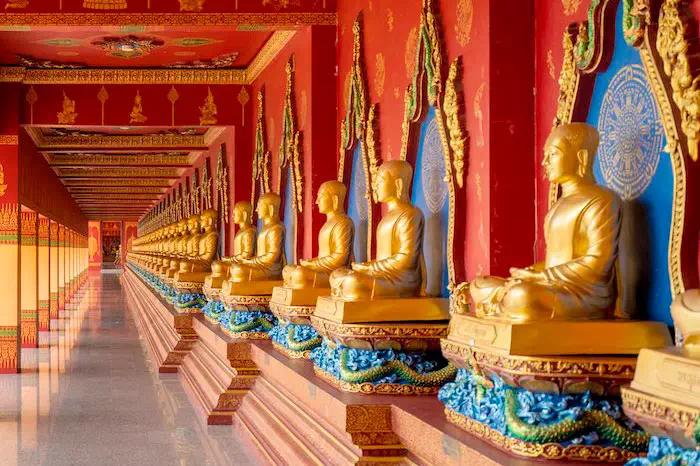
Never climb on a statue or its base, and never touch its head. Skip the funny poses: no pretending to hold the Buddha in your palm, no hands on shoulders, no kissing shots. Many Thais also feel uneasy when visitors turn their backs on an image for a selfie, so stand side-on, or just ask a friend to shoot you from a respectful distance.
Turn the flash off indoors. Some halls ban photos altogether, usually with a clear sign, and a few rooms that hold relics do too. If you are unsure, watch what local people are doing, or ask with a raised phone and a smile.
Ask before you photograph a monk close up, and do not photograph people who are in the middle of praying. A wide shot of a courtyard with a few robes in the distance is fine. Your face filling a monk's frame while he is reading is not.
Buddha souvenirs need thought too. Do not put an image on the floor or in your back pocket, and do not buy one as a garden decoration or a doorstop. Taking a Buddha image out of Thailand can also require permission from the Fine Arts Department, so ask the shop and check the current rules before you buy anything large or old-looking.
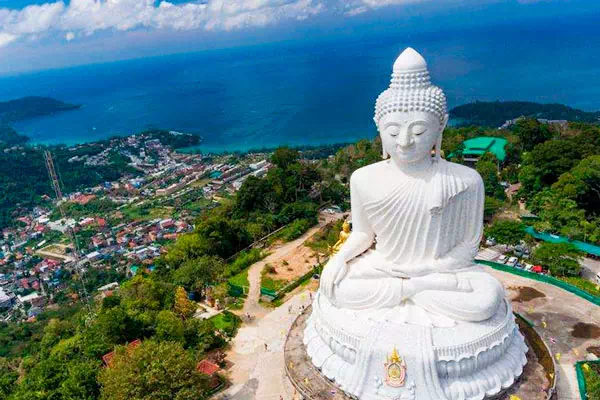
The rules are the same, but the feel is not. Wat Chalong is an active working temple where you will see Thais at prayer, while Big Buddha is a huge hilltop site that attracts far more tour groups.

At Wat Chalong, the largest and most revered temple on the island, people press gold leaf onto the statues of the monks Luang Pho Chaem and Luang Pho Chuang, who are remembered for helping locals during the tin miners' uprising in the 1870s. Do not stand in front of them to photograph. Inside the tall chedi, which is said to hold a relic of the Buddha, walk around calmly and go clockwise when you circle anything sacred. Those loud bangs you may hear are firecrackers let off by people giving thanks for wishes that came true, not an emergency.
At Big Buddha, the site is still very much a place of worship, even when it looks like a viewpoint. Wraps are usually available at the entrance, so ask if you need one. You may see a monk offering blessings by tying a white string around the wrist. If you are a woman, he will not touch your arm, so someone else may tie it, or he will drop it gently into your palm. Donations help to pay for the ongoing construction, so give only if you want to, and never feel pressured.
| Place | Feel | Main thing to remember |
|---|---|---|
| Wat Chalong | Active temple, Thai worshippers, firecrackers | Give people room at the statues and stay quiet in the halls |
| Big Buddha | Hilltop site, big views, tour groups, wind and sun | Stay respectful on the platform even when it feels like a viewpoint |
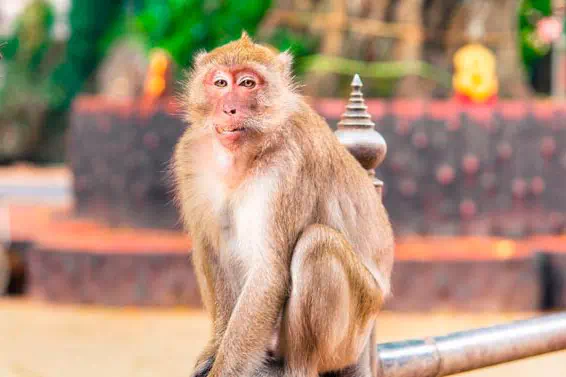
| Cave temples near Phang Nga | Dim halls, many images, often monkeys nearby | Quiet voices, no flash, hold on to your snacks and bags |
Temples on Phuket are easy to combine in a single day if you hate planning. The Phuket City Tour includes Big Buddha and Old Phuket Town with a guide who can explain what you are looking at, which beats wandering around guessing. The tour page has the current list of stops, so check it if Wat Chalong matters to you.
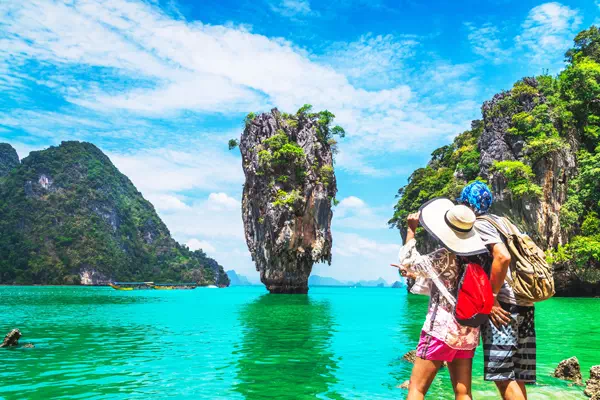
Etiquette also travels beyond Buddhism. The stilt village of Panyee, which is a stop on the James Bond Island tour (though not on the large ship version), is mostly Muslim, so cover up with a shirt and shorts when walking through. It is a courtesy people notice.
Two day trips suit people who want a cultural side to their holiday. The Phuket City Tour (from ฿1090) suits first-timers who want the island's main sights without a rental bike, and the Phang Nga Bay tour (from ฿1890) suits people who care more about scenery and a long day out.
Run through this at the gate. Clothes and shoes solve most of it, and the rest is simply slowing down.
Go early if you can. Before about ten in the morning the stone is cooler, the groups are smaller and you will see more real temple life. Visit on a Buddhist holy day and expect more worshippers, so give them extra room. On those days alcohol sales may also be restricted across the country, so check locally if you are planning an evening out.
If you get something wrong, do not panic. A small wai, a smile and a quiet "khor thot" (sorry) fixes nearly all of it. For more ideas on filling the rest of your trip, the home page lists every tour we book, and you can send a question on WhatsApp or through the booking request on any tour page.
Most temples on the island let you walk in without a formal ticket, and a donation box is the usual way to contribute. Giving is your choice, even a small amount is appreciated. Rules and fees can change, so check on the day at bigger sites.
Yes, Thai families bring children all the time. The same dress code applies, though nobody will expect perfection from a toddler. Explain the feet and statue rules before you go in, and take a restless child out to the courtyard for a break.
Knee-length shorts are generally accepted at Phuket temples, especially for men. Some stricter temples and royal sites elsewhere in Thailand want long trousers or skirts. If in doubt, carry a sarong and you will never have to argue about it.
Almost everywhere, but not always. Some chedis and inner shrines, more often in northern Thailand, are closed to women, and a sign will usually tell you so. Treat the sign as you would any other house rule, and do not be offended.
Amulets are worn by many Thais and are fine if you treat them with care, so keep them above the waist. Buddha images on T-shirts, swimwear or anything worn on the lower body can offend people. I would leave those at home for temple days.
Usually yes, if you stay at the back and keep quiet. Sit with your feet tucked away, keep your head lower than monks who are seated, and do not walk between them and the altar. If it looks like a private family event, step back and watch from outside.
Use the wai: press your palms together at chest height and bow your head slightly. You do not need to start a wai with a shop vendor or a child, but returning one is always polite. In a temple, a wai towards the main Buddha image when you arrive is a nice gesture.
Hotel pickup, insurance and a licensed local operator. Ask us anything on WhatsApp before you book.
Updated 24 November 2026.