

You Might Also Like
WhatsApp, Telegram +66-957-269-990
- info@gophukettours.com


Speedboat, big tourist boat or public ferry: each gets you to Phi Phi, but the days feel completely different. Here is how they compare on stops, comfort, seasickness and time on the islands, and which one fits you.

The night before a Phi Phi day, the same question comes up over dinner in Patong and Kata: speedboat or big boat? One friend wants to see everything, another is worried about feeling sick, and someone has read that the big boats are "more relaxing". Choosing between a Phi Phi speedboat or big boat is the real decision behind the trip, so it is worth getting right.
I have done both many times, with friends, with family and with guests who were nervous about the sea. Neither option is always better. This guide compares them honestly on stops, comfort, seasickness, time on the islands and group feel, so you can choose for the people you are travelling with.
The real difference is a trade between places and comfort: a speedboat sees more of Phi Phi, a big boat gives a smoother but narrower day. Everything else, from the lunch to the crowd, follows from that choice.
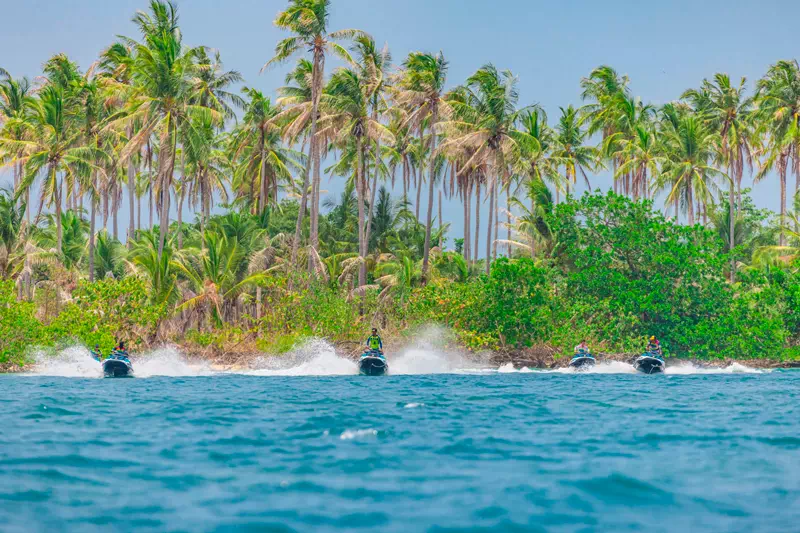
A speedboat tour is a fast, open boat with rows of seats under a canopy. It moves quickly between stops, so you get the full loop: Maya Bay, Pileh Lagoon, Viking Cave, Monkey Beach, a snorkel stop, lunch and a final beach. It is lively and a bit wet, and you feel every wave.
A big boat means either a large tourist boat or a public ferry. Tourist boats are slower and steadier, with indoor seats, a toilet and space to walk around. They usually visit fewer places, because a big hull cannot slip into the small bays. Some switch guests to smaller boats for certain stops, which adds time.
The public ferry is a different thing again. It is transport, not a tour. It takes you from Phuket to the main village on Phi Phi Don and back, and what you do in between is up to you. It suits people who are staying overnight, not people who want a day of sightseeing.
| Factor | Speedboat tour | Big tourist boat | Public ferry |
|---|---|---|---|
| Number of stops | Many, the full Phi Phi loop | Fewer, main sights only | One: the village on Phi Phi Don |
| Small bays and lagoons | Yes, gets right in | Often seen from outside or by transfer | No |
| Ride comfort | Bumpy in waves, can be wet | Steady, shade, toilet on board | Steady, indoor seats |
| Seasickness risk | Highest on choppy days | Lower | Lower |
| Time travelling | Short crossings | Longer crossings | Longer crossing, then you are on your own |
| Time on islands | Many short stops | Fewer, longer stops | As long as you like on Phi Phi Don |
| Group feel | One boat, one guide, everyone together | Larger crowd, more like a cruise | Ferry passengers, no guide |
| Best for | First-timers who want to see it all | Older travellers, small kids, easy days | Overnight stays on Phi Phi |
A speedboat tour gives you the most stops by far, because speed and a small hull let it reach places big boats cannot enter. A big boat covers the headline sights but leaves gaps.
On the Phi Phi Islands Tour from Phuket, which runs on a speedboat, the day starts at the pier with tea or coffee and a short briefing from the guide. Then the boat heads for Maya Bay first, before the crowds build. From there you go to Pileh Lagoon, Viking Cave and Monkey Beach.
After that comes a coral reef snorkel stop, a buffet lunch on Phi Phi Don with free time on the beach, and a final stop at Khai, Bamboo or Maiton island on the way back, depending on the program. That is a lot for one day, and the 9 hours including transfers go quickly.

Pileh Lagoon is the clearest example of what you miss on a big boat. It is enclosed by tall limestone walls with deep, clear water around 20 meters, and you swim straight off the side of the boat. Larger boats often cannot squeeze in, so their guests see it from the entrance or skip it.
A big tourist boat typically focuses on a few main stops: a view of Phi Phi Leh, lunch and a beach. It is a good day, just a different one. If you only want one beach, a long lunch and an easy ride, you may not miss the extra stops at all.
A big boat is more comfortable on the water, while a speedboat is more comfortable overall if you hate long, slow crossings. Comfort on a speedboat depends almost entirely on the sea that day, so the season matters a lot.

On a big boat you can get up, walk around, sit in shade or in the sun, use a proper toilet and stay dry. On a hot day that freedom is worth a lot, especially for older travellers. The downside is time: the crossings are longer, and the day can feel like waiting between short stops.
On a speedboat you sit in rows, and on a calm morning the ride is fun: fresh air, spray and quick hops between islands. On a choppy day the front seats bounce hard and you will get splashed. Life jackets are on board and the crew helps everyone on and off, but it is never a lounge.
My honest view: in the dry season, from roughly November to April, the speedboat is comfortable enough for almost everyone. In the rainy months, when swell comes in from the Andaman Sea, the bigger the boat, the happier sensitive passengers will be.
Seasickness risk is higher on a speedboat, especially on choppy days, because a small fast boat moves with every wave while a big hull rides through them. But with the right seat and some preparation, most people who worry about it are fine.

These are the tips I give every friend who gets queasy at sea:
If you get very sick even on ferries and lake boats, be honest with yourself. A big boat or a mainland trip may be the kinder choice. The James Bond Island tour runs in the sheltered water of Phang Nga Bay, and its tourist ship option is calmer than an open sea crossing.
One thing I would not do is avoid Phi Phi completely because of a fear of seasickness. Most people who prepare well feel fine within minutes, and the stops in the lagoons and bays are in calm water. It is the crossing that tests you, not the swimming.
For families with school-age kids who like water, a speedboat is usually the better day, because short hops and many swim stops keep children busy. For babies, toddlers and anyone with back or neck problems, a steadier boat is the safer choice.
Kids tend to love the speedboat itself. It feels like an adventure, the stops come quickly and there is always something new: monkeys on the beach, a cave, a lagoon to jump into. Long, slow crossings on a big boat can bore them, which is not fun for anyone.

The bumps are the real concern. A choppy crossing is hard on very small children, and it is not advised for pregnant women or people with back injuries. If that is your family, ask on WhatsApp about the sea forecast before booking, or choose a calmer trip.
A few family tips from experience:
If you are travelling with very young kids and want something easier, the Racha, Coral and Maiton islands tour is a gentler beach day closer to Phuket, with lots of time in shallow water.
On a speedboat tour you get many short stops, while on a big boat you get fewer, longer ones. Total time in the water and on the sand is often similar; what changes is how it is spread.
The speedboat day is a sequence of highlights. You see Maya Bay, swim in Pileh Lagoon, look at Viking Cave from the boat, stop at Monkey Beach, snorkel at the reef, then have lunch and free time on Phi Phi Don. The last stop at Khai, Bamboo or Maiton is your chance to relax properly before heading home.

Some people find the pace too busy. If you like to settle on one beach with a book for three hours, the speedboat format is not for you. A big boat day, or a ferry and an overnight stay, gives you that slower rhythm.
Others love the variety and say it feels like seeing a week of Thailand in a day. For a first visit, I am firmly in that camp. You can always come back for a slow beach day later, but you will not see Pileh Lagoon from a big boat.
Choose the speedboat if you want to see the whole of Phi Phi in one day and the sea is not a big worry. Choose a big boat or a calmer trip if comfort and a steady ride matter more than the number of stops.

Here is how I would match the boat to the traveller, based on years of sending friends out to Phi Phi:
The speedboat tour suits anyone who wants the full Phi Phi loop in a day. The James Bond Island tour suits people who want calmer water and limestone scenery. The Racha and Maiton day suits families who mainly want beach time.
A few small things make either boat day better. Most of them are about the weather and what you carry.
Check the forecast and wind the day before, and do not be shy about asking. If the sea looks rough, the team can tell you whether the boats are running normally or whether another date would be kinder. Trips can change their route on the day for safety, and that is a good thing.
Think about where you are staying, too. Pickup from the west coast beaches means an early start, and the ride to the pier takes a while in morning traffic. Go to bed early, set out your bag the night before and have breakfast ready, because the speedboat day rewards people who arrive rested.
Wear your swimsuit under your clothes, bring a dry bag for your phone and use reef-friendly sunscreen. On the speedboat tour, the hotel transfer, drinks, lunch, guide and snorkeling gear are included, so you only need a towel and personal things. For a full picture of the route, read what to expect on a Phi Phi island tour from Phuket.
On a calm day it feels fast and fun rather than scary. On a choppy day the front seats bounce and you will get splashed. Sit at the back, hold the rail when the boat turns, and it is fine for most people.
Day tours are not set up for suitcases, only a small bag with a towel and personal things. If you are moving to Phi Phi with luggage, the public ferry is the better option. Ask before booking if you have special needs.
Most days, yes, but the sea is rougher and some trips are changed or cancelled for safety. Routes can be adjusted on the day if some stops are not safe to reach. The dry season is the more reliable time for a smooth ride.
A speedboat gets closer to cliffs, caves and lagoons, which gives better photos of the famous spots. A big boat has a higher, steadier deck for wide views. If photos are a priority, the speedboat wins.
Usually a little, especially near the front or on windy days. Keep your phone and camera in a dry bag and wear quick-dry clothes over your swimsuit. You will be swimming anyway, so most people do not mind.
Many older guests do it happily, especially in the calm dry season. Getting on and off the boat needs some balance, and the crew helps. If you have back or joint problems, mention it when you book so the team can advise.
Speedboats are small and toilet facilities are limited or absent. There are toilets at the pier and at the lunch stop on Phi Phi Don. Use them before you board each time.
Hotel pickup, insurance and a licensed local operator. Ask us anything on WhatsApp before you book.
Updated 2 November 2026.